From Manual Modeling to AI Generation
Creating 3D models used to take ages. Think hours, days, even weeks of work. Artists and designers spent countless hours painstakingly shaping digital clay, moving vertices, and applying textures by hand. This required great skill and specialized software, making it tough for many to even get started. It was a world built by experts, for experts.
Then came AI. Suddenly, the game changed. Instead of building everything from scratch, we can now describe what we want. This is the core idea behind text-to-3D technology. You type a description, like “a rusty medieval sword with a glowing gem,” and the AI figures out how to build it. This shift means less time spent on tedious tasks and more time for creative ideas.
The barrier to entry for 3D creation has dramatically lowered. What once required years of training can now be approached with simple language. This evolution is not just about speed; it’s about making 3D accessible to a much wider audience, from hobbyists to small businesses.
The Impact of Machine Learning on Visual Design
Machine learning has really shaken things up in visual design. Before, designers had to manually adjust every little detail to get a certain look. Now, AI can learn from massive amounts of data to understand styles, textures, and forms. This means it can help generate visuals that fit specific aesthetics or even create entirely new ones.
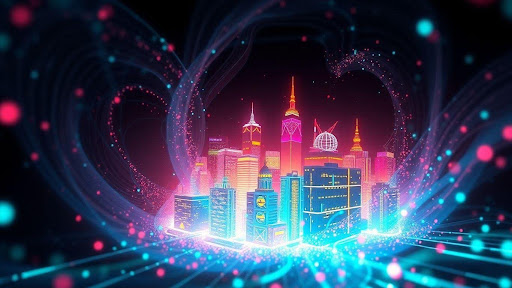
Think about it: AI can analyze thousands of images to understand what makes a “cyberpunk city” look like one. It learns the common elements, the lighting, the mood. Then, when you ask for a cyberpunk city using text-to-3D, it draws on that learned knowledge. This ability to learn and apply complex visual rules is what makes AI so powerful for designers.
This isn’t just about making things look pretty; it’s about efficiency. AI can automate repetitive design tasks, freeing up human designers to focus on the bigger picture and more innovative concepts. It’s a partnership, where AI handles the heavy lifting of pattern recognition and generation, and humans provide the direction and artistic vision.
Understanding Text-to-3D Model Fundamentals
So, how does this text-to-3D magic actually work? At its heart, it’s about AI understanding language and translating it into a 3D shape. It uses complex algorithms, often involving neural networks, that have been trained on vast datasets of text and corresponding 3D models.
When you input a prompt, the AI breaks it down. It identifies key objects, attributes, styles, and relationships described in your text. For example, “a red sports car” tells the AI to look for car shapes, specifically sports car types, and to apply a red color. The more detailed the prompt, the more specific the AI can be.
The process involves several stages: interpreting the text, generating a rough 3D form, refining the geometry, and often adding textures and materials based on the description. It’s a sophisticated process that’s getting better all the time.
This technology is still developing, but its core function is to bridge the gap between human imagination and digital creation. The goal is to make the creation of 3D assets as simple as writing a sentence, opening up new possibilities for everyone.
Transformative Applications Across Industries
Revolutionizing Entertainment and Gaming
The entertainment and gaming sectors are seeing a massive shift thanks to text-to-3D technology. Creating detailed game worlds and unique characters used to take ages and a lot of money. Now, with just a few words, developers can quickly generate assets, speeding up development and letting them try out more wild ideas. This means faster game releases and more imaginative virtual experiences for players. The ability to generate 3D models from text is a game-changer for creative teams.
Imagine a game designer describing a “glowing, alien forest” and instantly seeing a 3D model of it. This rapid prototyping is what text-to-3D model tools offer. It’s not just about speed; it’s about unlocking new levels of creativity. This technology is making complex 3D asset creation accessible to more people.
- Rapid Prototyping: Quickly visualize game environments and character concepts.
- Cost Reduction: Less time and fewer specialized artists needed for initial asset generation.
- Creative Exploration: Experiment with more diverse and unique designs without high upfront investment.
This technology is fundamentally changing how we think about building virtual worlds, making them richer and more dynamic than ever before.
Enhancing Architecture and Product Design
Architects and product designers are also benefiting greatly. Traditionally, creating detailed 3D models for presentations or prototypes involved a lot of manual work. Now, a designer can type “a minimalist living room with a large window and a modern sofa” and get a starting 3D model. This makes it much easier to show clients what a building or product will look like and to make changes on the fly.
This text-to-3D model capability bridges the gap between an idea and a visual representation. It allows for quicker design iterations and clearer communication with stakeholders. For product designers, it means faster creation of product mockups for review or marketing.
- Client Visualization: Present design concepts with greater clarity and detail.
- Iterative Design: Make design adjustments quickly based on feedback.
- Concept to Reality: Accelerate the process from initial sketch to tangible 3D model.
Impacting E-Commerce and Marketing Visuals
Online shopping demands good product images. Making 3D models of products for websites used to be expensive and slow. Text-to-3D model tools change this. Businesses can now generate 3D models of their products just by describing them. This is great for showing off furniture, electronics, or even clothing in a more interactive way online.
This technology helps create engaging marketing materials too. Instead of static images, companies can use 3D models to let customers view products from all angles or even place virtual items in their own space using AR. The impact of text-to-3D on how products are presented online is significant.
- Interactive Product Views: Allow customers to explore products in 3D.
- Virtual Try-Ons: Enable customers to see how products might look in their environment.
- Marketing Content: Create dynamic visuals for advertisements and social media campaigns.
The ability to generate 3D assets from simple text descriptions is democratizing visual creation across these diverse fields.
Democratizing Digital Creation
Broadening Accessibility for Aspiring Creators
Text-to-3D technology is really changing the game for people who want to make 3D stuff but don’t have the fancy software or years of training. It’s like opening a door that was previously locked. Now, anyone with an idea can just type it out and see a 3D model appear. This makes creating digital assets much less intimidating. The barrier to entry for 3D creation has dropped significantly.
Think about it: instead of spending ages learning complex modeling programs, you can focus on your creative vision. This accessibility means more people can experiment and bring their ideas to life. It’s a big deal for hobbyists and students who might not have the budget for professional tools. The text-to-3D process is becoming a lot more approachable.
This shift is happening fast. New tools are popping up all the time, and many offer free trials or limited free use. It’s a great way to get started and see what’s possible without a big financial commitment. The goal is to let more voices be heard in the digital space.
Empowering Small Businesses and Educators
Small businesses and educators are also seeing huge benefits from this new wave of text-to-3D technology. Before, getting custom 3D models for a product or a lesson plan could be really expensive and time-consuming. Now, they can generate what they need quickly and affordably.
For a small online shop, this means they can create unique 3D models of their products for their website, making them stand out. For teachers, it means they can create interactive 3D visuals for lessons on anything from history to science, making learning more engaging. It’s about making powerful tools available to everyone, not just big companies.
This technology helps level the playing field. It gives smaller operations the ability to compete with larger ones by having access to similar creative capabilities. It’s a smart way to get high-quality visuals without breaking the bank.
The Rise of Free Text-to-3D Animation Tools
One of the most exciting parts of this trend is the availability of free text-to-3D animation tools. These platforms are making advanced 3D animation accessible to a much wider audience. You don’t need a Hollywood budget anymore to create animated 3D scenes.
These free tools often work on a credit system or have generous free tiers, letting users experiment with generating animations from simple text prompts. This is a massive change from the past, where animation software and rendering farms cost a fortune. It allows for rapid prototyping and iteration, which is great for testing ideas.
The availability of free text-to-3D animation tools is a game-changer, allowing individuals and small teams to produce professional-looking 3D content without significant financial investment. This democratization fuels innovation and broadens the scope of digital storytelling.
Here are some ways these tools are helping:
- Rapid Prototyping: Quickly generate animated 3D concepts to visualize ideas.
- Educational Use: Students can learn animation principles without expensive software.
- Content Creation: Indie game developers and YouTubers can create assets more easily.
- Personal Projects: Bring personal creative visions to life in 3D animation.
Navigating the Text-to-3D Landscape
Exploring Available Tools and Platforms
The world of text-to-3D model generation is expanding fast. Lots of tools are popping up, some for pros, others for folks just starting out. It’s smart to check out demos and free trials first. See what these systems can actually do. Look for ones that are easy to use and let you tweak things to fit what you need. Getting a feel for different platforms helps you find the best fit for your projects.
Mastering Natural Language Prompt Engineering
Getting good results from a text-to-3D model system really comes down to how you write your prompts. Be specific. Mention the shape, the surface look, the colors, and any special details. It’s like giving clear instructions. The better your description, the closer the AI gets to what you imagine. It takes some practice, but learning to write good prompts is key to making the most of this tech.
Embracing Iterative Design Processes
One big plus with AI 3D model generators is how fast you can try things out. Don’t be afraid to experiment. Start with a simple idea, then add more details in the next try. Many tools let you refine the model based on what you see. This back-and-forth makes it easier to get the exact look you want. It’s a much quicker way to design than older methods.
The ability to quickly generate and refine 3D assets from simple text descriptions is changing how we think about digital creation. It lowers the barrier to entry significantly.
- Start Simple: Begin with basic descriptions.
- Add Detail: Gradually refine your prompts.
- Review and Adjust: Use the tool’s features to tweak the output.
- Learn from Others: Join online communities for tips and inspiration.
Leading Text-to-3D Generator Tools in 2026
Key Features of Advanced AI 3D Model Generators
Advanced AI 3D model generators in 2026 are pushing boundaries. They offer incredible detail and speed. The ability to generate complex scenes from simple text prompts is becoming standard. These tools understand nuanced language, allowing for precise control over the output. Expect features like real-time rendering previews and extensive material libraries. Leading text-to-3D generator tools in 2026, such as those highlighted by 3DAIStudio’s comparison guide, showcase how quickly these features are evolving and becoming more accessible.
Key features often include:
- High-fidelity mesh generation: Creating detailed and clean 3D geometry.
- Advanced texturing and material application: Applying realistic surface properties.
- Animation rigging and basic motion generation: Setting up characters for movement.
- Integration with existing workflows: Compatibility with popular 3D software.
These generators are built on sophisticated machine learning models trained on vast datasets. This allows them to interpret a wide range of descriptive language and translate it into visual 3D assets. The focus is on making the process intuitive, even for those without deep technical 3D modeling backgrounds.
Comparing Top Text-to-3D Solutions
Choosing the right text-to-3D solution depends on your specific needs. Some platforms excel in character creation, while others are better suited for environmental design or product visualization. Many offer free trials or credit systems, making it easy to test them out. Look for tools that provide good control over the generated output and offer various export formats.
Here’s a quick look at what to consider:
| Feature | Solution A (Example) | Solution B (Example) | Solution C (Example) |
| Ease of Use | High | Medium | High |
| Output Quality | Very High | High | High |
| Speed | Fast | Medium | Fast |
| Customization | Extensive | Moderate | Extensive |
| Pricing Model | Subscription | Pay-per-use | Freemium |
When evaluating different text-to-3D model tools, consider the complexity of your projects. A simple object might be generated quickly by many tools, but creating an intricate scene with specific lighting and character interactions requires more advanced capabilities. The text-to-3D process is rapidly evolving, so staying updated on new releases is key.
Future Trends in AI-Powered 3D Asset Creation
The future of AI-powered 3D asset creation looks incredibly bright. We’re moving towards even more photorealistic outputs and greater interactivity. Expect AI to handle more complex animation tasks, reducing the need for manual keyframing. Integration with virtual and augmented reality platforms will also become more common, allowing for real-time 3D content generation within immersive environments.
The ongoing development in AI text-to-3D generation is focused on improving fidelity, coherence, and controllability. This is moving us closer to seamless, photorealistic animation production directly from text descriptions.
Furthermore, the democratization of these tools will continue. More free and accessible options will emerge, lowering the barrier to entry for aspiring creators and small businesses. The ability to generate 3D models and animations from text is set to revolutionize many industries, making digital creation more efficient and imaginative than ever before. The evolution of the AI 3D model generator from text is a continuous journey.
The Future of AI in 3D Modeling

Enhanced Realism and Interactivity
AI is pushing the boundaries of what’s possible in 3D. We’re moving beyond basic shapes to incredibly detailed and lifelike models. Think about generating a scene from just a few words, and the AI not only creates the objects but also adds realistic textures and lighting. This means less time spent on tedious manual work and more time focusing on the creative vision. The goal is to make the generated 3D assets so good they’re almost indistinguishable from reality. This advancement is key for applications needing high visual fidelity.
Future AI systems will also offer more ways for users to interact with the generation process. Instead of just a one-off text prompt, imagine a back-and-forth conversation with the AI. You could ask for changes, tweak specific details, or adjust the mood of a scene in real-time. This iterative approach allows for much finer control, bridging the gap between automated generation and artistic direction. It’s about making the AI a true collaborator in the creative process.
The ability to refine models interactively will be a game-changer. This means you can start with a general idea, see what the AI produces, and then guide it towards your exact vision. This level of customization, combined with improved realism, means that AI-generated 3D content will become a standard tool for professionals and hobbyists alike. The text-to-3D model technology is evolving rapidly, promising more sophisticated outputs.
Seamless Integration with VR and AR
Virtual Reality (VR) and Augmented Reality (AR) need a constant stream of 3D content. AI, especially text-to-3D model tools, is poised to fill this need. Imagine quickly generating environments or objects for a VR experience just by describing them. This speeds up development significantly, making VR and AR applications more accessible and diverse.
These AI tools will likely integrate smoothly into existing VR/AR development pipelines. Instead of complex modeling software, creators could use simple text prompts to populate virtual worlds. This makes creating interactive experiences much easier, even for those without deep 3D modeling skills. The potential for personalized VR spaces or AR overlays is immense.
The synergy between AI-driven 3D generation and immersive technologies like VR and AR will redefine digital interaction. We’ll see more dynamic and responsive virtual environments created with unprecedented speed and ease.
Ethical Considerations and Copyright in AI Generation
As AI gets better at creating 3D models from text, questions about ownership and originality come up. If an AI is trained on existing copyrighted works, who owns the output? This is a big legal and ethical puzzle that needs solving. Developers and users must be mindful of how training data is sourced and used to avoid intellectual property issues.
There’s also the concern about bias in the AI’s training data. If the data isn’t diverse, the AI might produce models that reflect those biases, leading to skewed or unfair representations. Ensuring fairness and ethical use is paramount as text-to-3D model technology becomes more widespread. Responsible development is key.
The future requires clear guidelines on copyright and ethical AI practices. This will help build trust and ensure that AI-generated 3D content benefits everyone. It’s about making sure the technology is used responsibly and fairly, respecting the rights of creators and avoiding harmful biases. The ongoing development of AI 3D model generators must address these points.
The Road Ahead for Text-to-3D
So, where does all this leave us? Text-to-3D tech is really changing the game for anyone making digital stuff. It’s like going from needing a whole workshop to just needing a good idea and a keyboard. This means more people can jump in and create, which is pretty cool. We’re going to see even better models coming out, with more detail and realism, as the AI gets smarter. Plus, imagine hooking this up with VR or AR – you could literally describe a world and then step into it. It’s going to shake things up in gaming, movies, and even how we design products or buildings. It’s not perfect yet, and there’s still work to do, but the direction is clear: making 3D creation easier and more open to everyone. Keep an eye on this space, because it’s only going to get more interesting.