The shift from experimental AI art to professional creative production has fundamentally changed how studios approach asset generation. In the early days of generative media, the goal was often to find a “lucky” prompt that yielded a usable result. Today, the focus has pivoted toward reliability, repeatability, and the integration of diverse tools into a single, cohesive pipeline. For many creators, Nano Banana Pro has emerged as a central node in this transition, moving away from isolated generations toward an integrated studio environment.
To build a scalable visual pipeline, one must look beyond the initial text-to-image interface. A professional workflow requires an ecosystem that can handle high-resolution upscaling, selective in-painting, and the eventual conversion of static imagery into motion assets. When we evaluate tools like Banana Pro, we aren’t just looking for aesthetic quality; we are looking for how efficiently a single creative vision can be refined and deployed across different mediums.
The Architecture of an Integrated Workflow
A production-ready pipeline usually starts with a specific intent—whether that is a storyboard for a commercial or a set of social media assets. The traditional bottleneck in AI creative work is the lack of control. You might get 90% of the way there with a prompt, but that final 10% requires a surgical touch. This is where the AI Image Editor comes into play, serving as the bridge between raw generation and final delivery.
In a standard workflow, a creator might use Nano Banana to iterate on a concept. Once a base image is selected, the work doesn’t end; it transitions into a refinement stage. This stage involves masking specific areas for regeneration, adjusting lighting through image-to-image prompts, and ensuring that the composition adheres to the strict requirements of a brand’s visual identity. By keeping these functions within the same environment, creators reduce the friction of exporting and importing files between disparate platforms, which is a common source of metadata loss and workflow fatigue.
Refining the Output with Nano Banana Pro
One of the significant advantages of using a dedicated professional tier like Nano Banana Pro is the access to higher throughput and more granular model parameters. In a commercial setting, “speed to market” is a primary KPI. If a creative team is waiting ten minutes for a batch of high-resolution variations, the momentum of the project stalls.
However, speed is nothing without consistency. When using Nano Banana, creators often find that the model has a specific “voice” or aesthetic tendency. Learning to work with these tendencies, rather than fighting them, is key to scaling production. For example, if the model excels at cinematic lighting but struggles with specific architectural geometries, a savvy operator will use the generation engine for the lighting and environment, then rely on secondary editing tools to correct the structural elements.
It is worth noting that even with a robust model, we are not yet at a point where a “perfect” asset is guaranteed on the first try. There is an inherent uncertainty in how specific lighting prompts interact with complex textures. We have observed that Nano Banana occasionally interprets architectural depth in unexpected ways, requiring multiple iterations of the same prompt with slight weighting adjustments to achieve the desired spatial logic.
Leveraging the AI Image Editor for Precision
While the generation engine handles the “creative” heavy lifting, the technical finishing happens in the editor. A professional AI Image Editor is distinct from a traditional photo editor because it understands the semantic content of the pixels. Instead of just pushing pixels around, you are instructing the machine to rethink a specific section of the image based on its context.
For creators, this means the ability to change a character’s expression, swap out a product on a table, or extend a background into a wide-screen format without losing the original style. This level of control is what separates a hobbyist from a production lead. In a performance marketing context, this allows for rapid A/B testing. You can take a single successful generation and create ten variations with different background colors or secondary props in a fraction of the time it would take to reshoot a physical scene.
Bridging Static Imagery and Video Production
The modern digital landscape demands motion. A static image, no matter how compelling, often fails to capture the same engagement metrics as a short-form video. The Banana AI ecosystem addresses this by allowing creators to port their generated images directly into a video generation workflow.
The transition from image to video is often where pipelines break down. Many tools lose the fine details of the original image once the pixels start moving. In our testing, the jump from a static Nano Banana output to a motion sequence requires a careful hand. You have to define the motion intensity and the camera path precisely, or the AI might hallucinate unnecessary changes to the subject’s face or clothing.
There is a clear limitation here: the current state of AI video often struggles with complex physics, such as liquid pouring or intricate finger movements. Creators should set their expectations accordingly. Use the Banana Pro video tools for environmental atmosphere, slow-motion pans, and subtle character movements rather than high-octane, complex physical interactions.
Managing Consistency Across Large Asset Sets
For teams building a brand identity, the biggest challenge is maintaining “character” and “world” consistency across fifty or a hundred different assets. Using a unified platform like Banana Pro helps mitigate some of the randomness associated with generative models.
By utilizing “seeds” and consistent style descriptors across the Banana Pro suite, operators can create a visual shorthand for the AI. However, we must be honest about the current limitations of the technology. Even with advanced tools, achieving 100% pixel-perfect consistency across different camera angles remains a challenge. Most professional teams solve this by creating a “master” asset in the image editor and using it as a reference for all subsequent generations, effectively “anchoring” the AI to a specific visual baseline.
Operational Efficiency in the Banana Pro Ecosystem
From a business perspective, the decision to adopt a tool like Nano Banana is often driven by the “cost per asset.” Traditional photography or high-end 3D rendering can cost thousands of dollars per finished frame. Generative AI brings that cost down significantly, but only if the workflow is efficient.
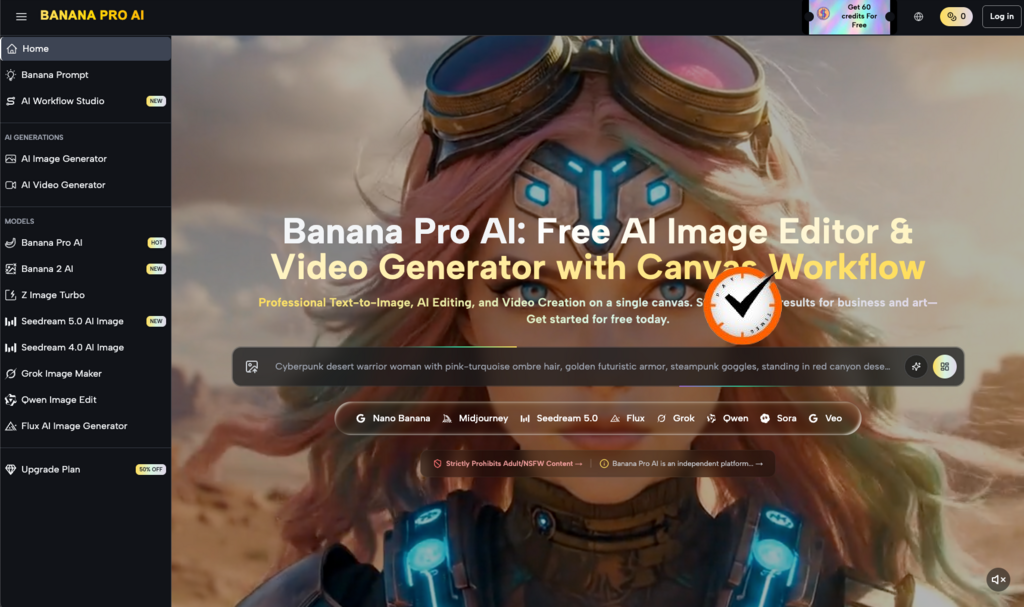
The “Canvas Workflow” found in modern AI studios is a game-changer for this efficiency. Instead of a linear “prompt-to-result” loop, a canvas allows for a non-linear approach. You can generate a character in the center, expand the canvas to the left to add a forest, and expand it to the right to add a cabin. This spatial way of working feels more like digital painting and less like coding, which aligns better with how creative professionals actually think.
Navigating the Limitations of Generative Tools
Despite the rapid advancement of Banana Pro and similar platforms, a healthy dose of skepticism is required for high-stakes production. We are still in an era where “AI hands” or “shimmering textures” in video can occur. A common mistake made by agencies is promising a client a fully AI-generated campaign without accounting for the human-led cleanup required at the end of the pipeline.
The AI is a collaborator, not a replacement for an art director. There is still a significant amount of manual oversight needed to ensure that a generation doesn’t include subtle hallucinations that distract from the product being sold. Furthermore, the copyright landscape for AI-generated assets remains in a state of flux, and creators should consult with their legal teams regarding the commercial use of these outputs in different jurisdictions.
Conclusion: The Future of Production-Savvy AI
Building a repeatable visual pipeline around Nano Banana Pro is about more than just knowing how to write a prompt. It is about understanding the interplay between the generation engine and the editing tools. It is about knowing when to let the AI take the lead and when to step in with the image editor to force a specific result.
As the Banana AI platform continues to evolve, we expect the friction between these different stages of production to decrease even further. The ultimate goal for any creator should be a workflow where the tool disappears, leaving only the creative vision behind. By mastering the nuances of the AI Image Editor and the specific strengths of the Nano Banana model, teams can move from “experimenting with AI” to “producing with AI” at a scale that was previously impossible.
The value isn’t just in the pixels—it’s in the process. By building a pipeline that accounts for the limitations of the technology while maximizing its creative latitude, you position yourself at the forefront of the next generation of digital media production. Stay practical, stay skeptical of the hype, and focus on the technical execution that leads to a finished, professional product.